TikTok FYP Views Low and How to Read the Real Signal
TikTok FYP Views Low and How to Read the Real Signal
TikTok FYP views low? The 200-view stall is a hook problem. The 80 percent collapse is a real restriction. Five minutes in Studio to know which.
- 1How TikTok’s FYP Distribution Really Works in 2026
- 2The Five-Minute Studio Diagnostic
- 3FYP Capping vs A Real Shadowban
- 4The IOU Hook Framework
- 5The 2-7-20 Retention Edit Rule
- 6The No-Reupload Rule and Why It Matters
- 7Recovery Timelines That Are Realistic
- 8Frequently Asked Questions
- Why are my TikTok views stuck at 200 to 400 on every video?
- How do I tell the difference between an FYP cap and a real shadowban?
- Does TikTok’s algorithm still test new videos against random audiences in 2026?
- Can I reupload a video that flopped to try a better hook?
- Is posting more often a fix for low FYP views?
- How long does it take to recover from a TikTok FYP slump?
- 9What to Do Right Now
TL;DR: A TikTok FYP views drop is usually one of two things and they need opposite fixes. A stall at 200 to 400 views is the algorithm reading a high swipe-away rate, which means your hook failed. A collapse to under 20 percent of your usual reach with engagement under 2 percent is a real shadowban. The diagnostic in TikTok Studio separates them in five minutes and the rest of this guide walks the IOU hook framework and the 2-7-20 retention rule that fix each one.
TikTok FYP views low is the search creators run when something feels wrong but Studio is not showing a red flag. The trap is that two completely different problems wear the same panic mask, and the fix for one is the opposite of the fix for the other.
Most creators react by deleting the underperforming video, posting another, and watching that one stall too. Three days into that cycle the algorithm has learned your account ships low-engagement content, which is the worst signal you can give it.
The right move is the five-minute diagnostic in TikTok Studio before you change a single thing about your posting. Your Studio analytics will tell you whether you are dealing with a hook problem on individual videos, an account-wide demotion event, or a real shadowban with hashtag-search invisibility.
What I would do is run that five-minute check first, then pick between the two recovery frameworks below based on what Studio shows. The IOU hook and the 2-7-20 retention rule fix the hook case. The 14-day shadowban recovery fits the restriction case. They are different problems and they need different playbooks.
How TikTok’s FYP Distribution Really Works in 2026
TikTok’s 2026 algorithm tests every new video against a micro-niche audience pool based on your account’s established topics, then expands distribution only if early-engagement signals pass the 27 to 35 percent completion rate threshold.
That micro-niche pool replaced the old “200 random users” model. If your hook fails inside the first three seconds of that test, the algorithm caps the video around 200 to 400 views and moves on.
What is the FYP test pool: A small audience of users TikTok algorithmically matches to your account’s topic cluster. They see your video first, and their watch-completion behavior determines whether the algorithm pushes the video to broader audiences.
In my experience, this is the single biggest 2026 shift creators have not caught up to. The old strategy was generic short clips with broad appeal hoping to break out. The new strategy is targeted content for a defined topic cluster, because the test pool is already pre-filtered to viewers TikTok thinks will care.
The platform’s audience itself has stabilized fast through 2026. TechCrunch reported that TikTok bounced back above 90 million daily active users in the United States after the ownership-change dip, which means the FYP test pools are dense and competitive again. A 200-view stall in 2026 is not a thin audience problem. It is a hook problem.
The engagement hierarchy also flipped. Saves and shares now carry the most weight in the ranking system. Likes carry significantly less weight, because likes are passive and the platform learned that a high-like-low-save Reel reads as scroll-by content. A Reel with 50 saves outperforms one with 500 likes in 2026 distribution.
For the broader context on this shift across platforms, why your Instagram reach dropped overnight covers the parallel algorithm change on Meta’s surfaces.
The Five-Minute Studio Diagnostic
The diagnostic that separates a hook problem from a real shadowban lives in three TikTok Studio tabs: Overview, Traffic Sources, and Account Status.
Run them in this order. The whole sequence takes about five minutes and tells you which recovery framework to use.
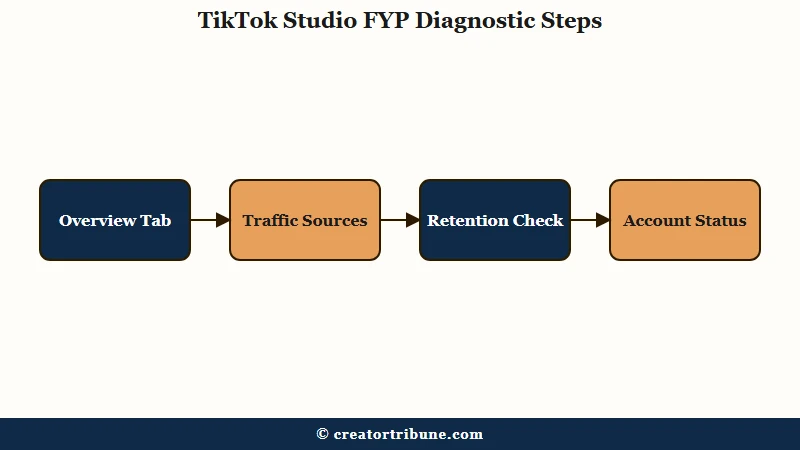
Here is the sequence I would walk through before changing any strategy.
- Open TikTok Studio and tap Analytics.
- Go to the Overview tab and compare the last 7 days of views to the 28-day average. A 30 to 50 percent drop is normal weekly variance. A 70 percent or more drop is a real event.
- Open Traffic Sources for your last 5 videos. Healthy distribution shows the majority of views from the “For You” page. If most traffic is coming from your Profile or your Followers tab, the algorithm is not pushing you to new audiences.
- Open Retention on your last 3 videos. A steep drop in the first 3 seconds is a hook problem. A gradual decline across the middle is a pacing problem.
- Go to Settings and Privacy, then Safety Center, then Account Status. Look for any violations or restricted posting privileges flagged on the account.
A pass on step 5 (no Account Status flag) and a fail on step 4 (steep first-3-second drop) means hook problem. Run the IOU framework below. A fail on step 5 means a real restriction event. Run the TikTok shadowban recovery walkthrough instead of the hook fix in this article.
FYP Capping vs A Real Shadowban
FYP capping is the algorithm reading a high swipe-away rate inside the first 3 seconds and stopping distribution. A shadowban is a separate ineligibility event where views collapse 80 to 90 percent and the account loses hashtag-search visibility.
They produce similar symptoms but require opposite fixes.
The cleanest way to tell them apart is the engagement ratio on the videos that did get views, not the view counts themselves.
| Symptom | FYP capping | Real shadowban |
|---|---|---|
| View count on new video | 200 to 400 stall | Down 80 percent or more from baseline |
| Engagement rate (likes + comments / views) | Normal (3 to 8 percent) | Under 2 percent |
| Account Status flag | None | Often present |
| Hashtag search visibility | Video appears under unique hashtag | Video missing under unique hashtag |
| Recovery timeline | 1 to 2 weeks of hook discipline | Up to 14 days, strikes 90 days |
| Fix path | IOU hook + 2-7-20 retention edit | 48-72h pause + cleanup + appeal |
The way I see it, the most common creator mistake is panicking at a 200-view stall and assuming shadowban, then mass-deleting old videos as a “cleanup.” Mass-deleting your own historically-performing content is one of the strongest signals TikTok reads as account instability.
The algorithm responds by capping more of your future videos, which the creator then reads as further shadowban evidence. The loop is self-reinforcing.
What I would do instead is hold the line on a 200-view stall for three to five videos, run the IOU framework on each one, and watch whether engagement ratio stays at 3 percent or higher. If it does, you are not shadowbanned. You are running 2024 hooks under 2026 rules.
The IOU Hook Framework
The 3-second hook framework that beats the FYP test pool in 2026 is IOU: Identify, Outcome, Unusual.
Identify means call out the specific viewer this is for in the first second. Outcome means promise a specific result by the end. Unusual means create a visual pattern break in the first frame that interrupts the scroll.
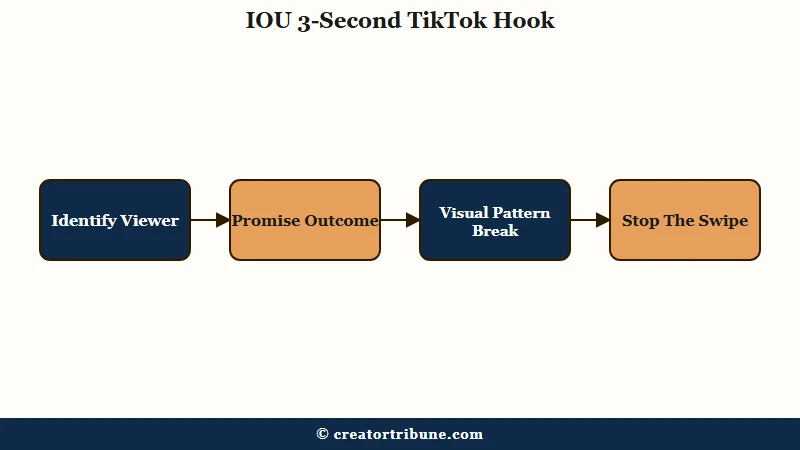
Worked example of a hook rewrite under this framework.
Vague: “Today I’m going to talk about how my TikTok views dropped and what I did about it.”
Specific: Frame 1: “TikTok creators: if your views stalled at 200 last week (Identify), I’ll show you the three Studio tabs that tell you why in five minutes (Outcome).” Visual: zoom-in on a phone screen showing Studio’s red 90 percent retention drop graph (Unusual).
The specific version does three things in 3 seconds. It self-identifies the viewer (TikTok creators with a recent stall), it promises a measurable outcome (five-minute diagnostic), and it shows a visual pattern (the Studio graph) instead of a generic talking head.
From my testing, the Identify lever is the one most creators skip. They open with a generic statement that could apply to anyone, the algorithm reads the swipe-away rate, and the video caps. Calling out the specific viewer narrows your test pool match probability and lifts watch-through immediately.
The 2-7-20 Retention Edit Rule
The retention edit rule that holds attention past the 15 to 20 second TikTok distribution threshold is 2-7-20: hook delivered by 2 seconds, visual proof or new info by 7 seconds, payoff or twist by 20 seconds.
Reset beats every 5 to 7 seconds after that until the end. The pattern works because it matches how TikTok’s algorithm samples retention.
Reset beats are visual or audio interrupts at predictable spots: zooms, text overlays, angle changes, sound effect punches. They are not transitions for transitions’ sake. Each beat resets the viewer’s “should I keep watching” decision so the algorithm sees continued engagement instead of a steady decline.
Here is the structure I would use on a 25-second educational Reel.
- Second 0-2: IOU hook with on-screen text matching the spoken hook.
- Second 3-7: First payoff point with a B-roll cut or zoom.
- Second 8-12: Reset beat (angle change or visual punch) plus second point.
- Second 13-18: Second reset beat plus third point or transition to twist.
- Second 19-25: Payoff or twist with a strong outro line and clear CTA.
The mistake most creators make is treating the middle of a Reel as filler. The middle is where the algorithm reads continued retention as the strongest distribution signal. From what I have seen, every reset beat past second 5 lifts watch-through by another 2 to 4 percentage points on educational content.
For cross-platform retention work, the same pacing rules apply to YouTube Shorts. The YouTube Shorts views stopped guide covers the Shorts-specific version of these signals.
The No-Reupload Rule and Why It Matters
TikTok’s 2026 automated filters detect reused content even when you reupload your own video with minor edits, and any flagged reupload deepens an existing distribution problem.
This applies to your own historical content too, not just other creators’ videos. Mirroring the video horizontally, adding B-roll, or changing the music does not always pass the unoriginal-content detector.
The reupload trap is one of the costliest mistakes I see during a panic-recovery cycle. A creator’s video stalls at 200 views, they assume the algorithm just missed it, they reupload tomorrow with the music swapped, and the reupload caps at 80 views with a worse engagement ratio because the platform now reads the account as a low-effort spammer.
The recovery move is to film fresh original content, not edit reuploads. If a piece of content genuinely worked once and you want to extend it, the right path is a follow-up Reel that references the original idea but is a different physical recording. Same script, new shoot. Same hook framework, new B-roll. The algorithm reads that as a content cluster, not a reupload.
There is one narrow exception. If a video performed well and you want to test a different hook on the same footage, TikTok allows it through the Edit feature in Studio rather than a fresh upload. The Edit feature is not flagged as reupload because the content remains under the original upload’s ID. That is the only safe way to A/B test hooks on a single video without triggering the spam filter.
Recovery Timelines That Are Realistic
Initial reach improvement from consistent IOU + 2-7-20 application typically shows within 1 to 2 weeks of disciplined posting at 3 to 5 videos per week.
Full recovery to peak performance is more like 2 to 8 weeks of steady output. The variance depends on how deep the demotion went before you caught it.
Here is the timeline I would set as an honest expectation.
| Recovery phase | Posting cadence | Expected signal |
|---|---|---|
| Week 1 | 3 to 5 IOU-framed Reels, niche-focused | Stop the stall, end mass-deletion |
| Week 2 to 3 | Same cadence, refine reset beats | Initial reach climb (10 to 25 percent) |
| Week 4 to 6 | Hold cadence, build content cluster | Steady reach growth (50 to 100 percent baseline) |
| Week 7 to 8 | Algorithm reweights you to new tier | Return to or exceed previous peak |
What works against the recovery is overposting (6+ Reels per day triggers spam filters), undeposting (one Reel a week is not enough signal to retrain), and switching topics mid-recovery (the topic cluster needs consistency to firm up).
Stick to 3 to 5 Reels per week on the same topic for the full 8 weeks if you want the recovery to hold.
If the FYP stall is happening alongside problems on Instagram and YouTube, the issue is usually a cross-platform content pattern rather than a TikTok-specific event. The cross-platform shadowban diagnostic covers the universal test that surfaces what is going wrong across all four major platforms.
Frequently Asked Questions
Why are my TikTok views stuck at 200 to 400 on every video?
That stall is FYP capping, not a shadowban. The algorithm tested your video against a micro-niche audience pool, the first 3 seconds failed the swipe-away threshold, and distribution stopped. Fix the hook with the IOU framework before assuming a restriction event.
How do I tell the difference between an FYP cap and a real shadowban?
Check the engagement ratio on videos that did get views. FYP capping shows normal engagement (3 to 8 percent) on the limited reach. A real shadowban shows engagement under 2 percent plus a flag in Account Status plus invisibility under unique hashtag search.
Does TikTok’s algorithm still test new videos against random audiences in 2026?
No. TikTok now tests new videos against a micro-niche audience pool matched to your account’s established topic cluster. That is why generic broad-appeal content stopped working and niche-specific content started compounding.
Can I reupload a video that flopped to try a better hook?
No. TikTok’s spam filter detects reused content even with edits or mirroring, and a flagged reupload deepens an existing distribution problem. Use TikTok Studio’s Edit feature to change captions or covers on the original upload, or shoot fresh footage. Do not reupload.
Is posting more often a fix for low FYP views?
No. Posting 6 or more times per day triggers the spam filter and restricts your account’s distribution power. The 2026 sweet spot is 3 to 5 niche-focused Reels per week with the IOU hook and 2-7-20 retention edit on every one.
How long does it take to recover from a TikTok FYP slump?
Initial improvement shows within 1 to 2 weeks of disciplined posting. Full recovery to peak performance takes 2 to 8 weeks. The exact timeline depends on whether you panic-deleted old videos before catching the problem, which extends recovery by 2 to 4 weeks.
What to Do Right Now
Run the five-minute Studio diagnostic before you change anything else. Open TikTok Studio, walk the Overview, Traffic Sources, Retention, and Account Status sequence. Note which check failed and which passed. The recovery path branches from what Studio shows, not from what the view counts feel like.
If retention drops sharply in the first 3 seconds and Account Status is clean, you have a hook problem. Apply the IOU framework on the next 5 videos and watch first-3-second retention climb in the analytics. Initial reach lift typically shows by week 2.
If Account Status shows a violation flag and engagement on your last 5 videos is under 2 percent, you have a restriction event. Pause posting for 48 to 72 hours, audit recent videos for community-guideline-adjacent content, and follow the TikTok shadowban recovery walkthrough instead of this article’s hook-recovery path.
If your TikTok stall is showing up alongside drops on Instagram and YouTube, the cross-platform pattern is the real signal. Start at the universal shadowban test and work through the per-platform sections from there.